Maritime data liberation and integration.
Connect the vessel-management systems and maritime solution providers your team already uses. OceanzHub Standard™ gives the data a route between them.
VMS systems
Veson · IMOS · Shiplex · NextVoyage
OceanzHub Standard™
Translate and validate
Maritime solutions
Providers your operation already uses
The data lock-in problem
Your maritime data is trapped in a VMS — and it cannot reach the specialized tools your operation wants to use.
- Voyage data stays in the VMS
- Bunker data lives in spreadsheets
- Compliance data is scattered
- Port-call data is tracked manually
- StormGeo / weather routing
- SPOS / route optimization
- Harborlab / port intelligence
- Spire / vessel tracking
- OceanBolt / market data
The route between those systems is the product: extract the data, translate it, validate it, and move it where it is needed.
How data moves through the route
Six steps describe the integration path. Select a step to see the source, destination, and work performed at that point.
Connect VMS
Connect an existing vessel-management system such as Veson, IMOS, Shiplex, or NextVoyage with a read-only connection.
Veson / IMOS / Shiplex / NextVoyage
OceanzHub
Fit the route to your maritime stack.
30+ connectors across the systems and provider categories below. Use the catalog for search, status, and connector details.
Need a specific provider or availability state?
See the route in action.
Start with a local product frame. The external demonstration loads only when requested, so an unavailable player never becomes a blank page section.
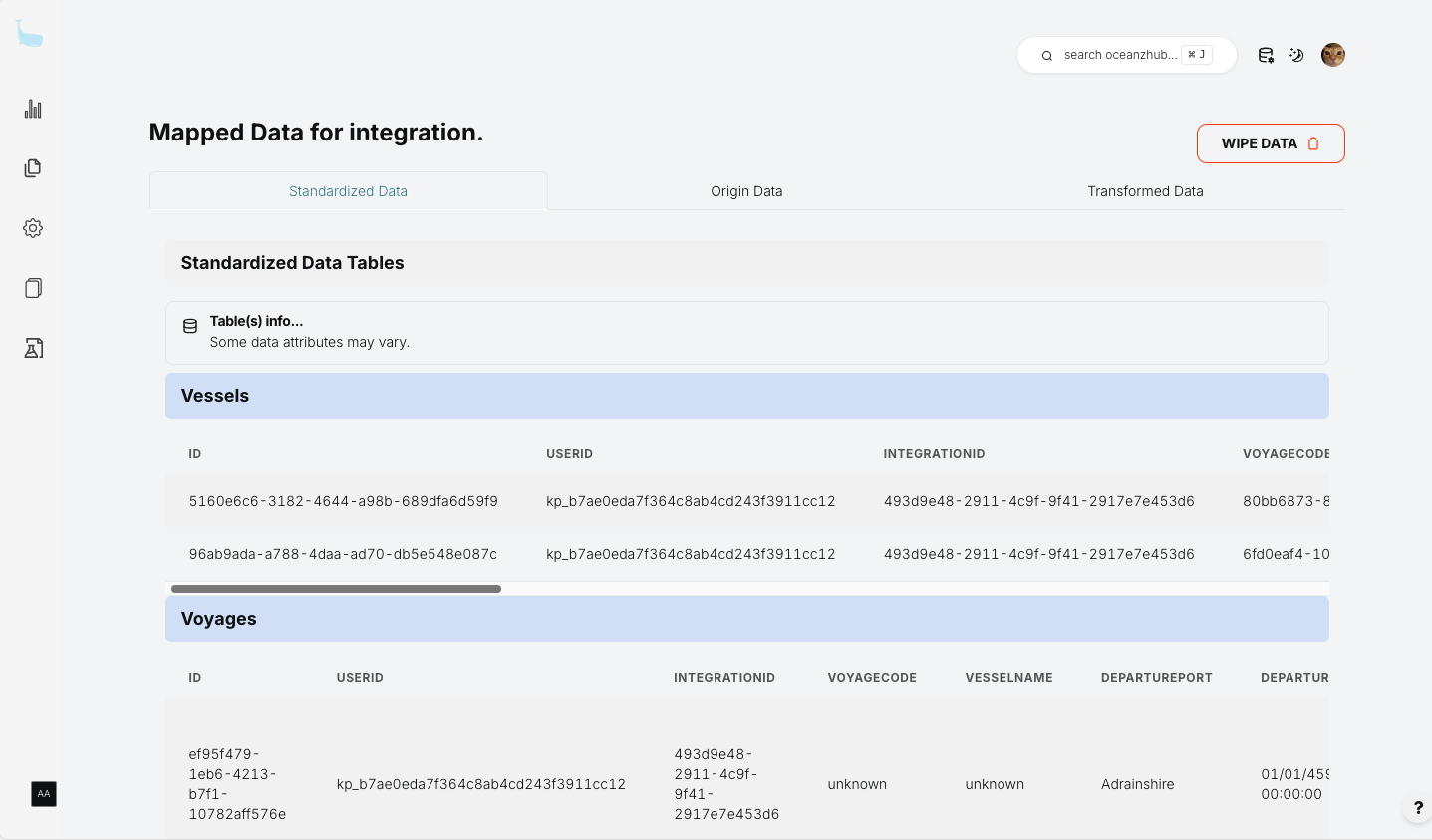
Mapped data for integration.
Calculate potential time returned.
A directional model for the manual work around maritime documents and system handoffs. Use your own costs and constraints for a business case.
- 75% estimated reduction in document processing time
- 10 hours returned per connected system / month
- Hours only — no currency or savings claim